
The Dig Explains: Understanding OUSD’s Facilities
I read the full 151-page Facilities Master Plan so you don’t have to, and here’s what I learned.
Hi! I’m Rachael Kirk-Cortez, a D5 resident who has a first grader and rising TK-er at Sequoia. I’m passionate about facilities because I’m passionate about climate. I researched this explainer and received much feedback from other parents, AND recognize I am at the beginning of my OUSD journey and am still learning. I hope this is the start of a conversation, so if you see something that you think could be better explained, holler @ me in the comments here or at ousdparentscommunity@gmail.com.
The OUSD Facilities Planning and Management Department has developed a draft 2026 Facilities Master Plan which “outlines proposed priorities and strategies to improve facilities in ways that better serve students, staff, and the community.” Put simply – this document will inform what work is done to maintain our schools, what principles guide that work, and will inform the bond measures that fund that work.
Facilities Fast Facts
- OUSD owns 110 school campuses that house district schools, charter schools, and Childhood Development Centers (Early Childhood Education/preschools), making it one of the biggest land-owners in Oakland.
- 20% of OUSD’s annual unrestricted budget is spent on utilities, representing the single biggest annual cost after staffing
- OUSD’s current enrollment uses only about 59% of planned capacity.
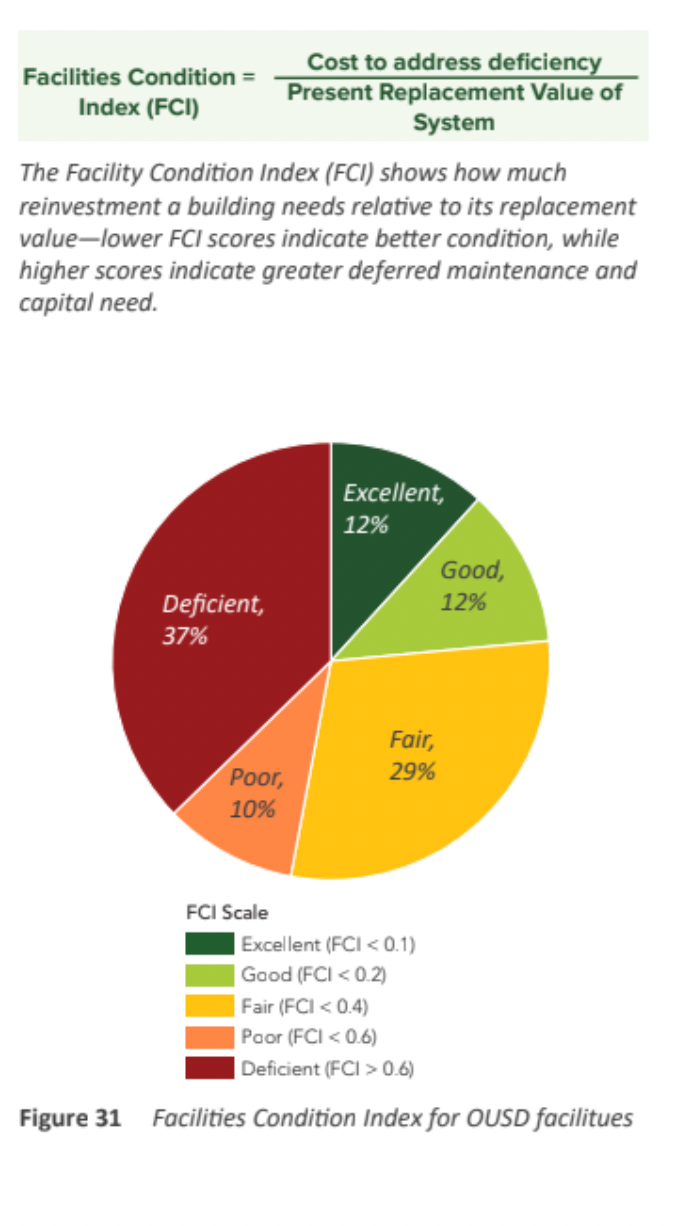
- Only 24% of OUSD school campuses are considered in good or excellent condition.
When you look at these facts, facilities represent a HUGE opportunity to live our values through our built environment. I read the full 151-page Facilities Master Plan so you don’t have to, and here’s what I learned.
Facilities Condition: A large and growing problem
How do you assess if a school building and yard are in good condition? OUSD uses two metrics: Facility Condition and Educational Adequacy.
Facilities Condition: how well-maintained a building is, as measured by how much it would cost to repair it relative to its replacement value
As the chart shows, the vast majority of OUSD buildings are not in good condition. This means infrastructure like electric systems don’t work well, schools may have inadequate heating and cooling systems (if they have cooling systems at all), that there are seismic issues with a building, or that major repair or maintenance is needed to a roof, floor, wall, or other part of the school.
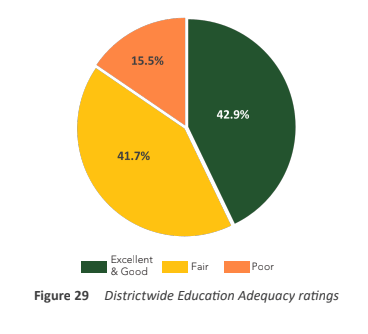
Educational Adequacy: how well each school supports modern learning expectations, examining the quality, functionality, and versatility of instructional and student-facing spaces.
This measures whether classrooms have adequate space, whether schools have spaces suitable for enrichment like art, science, PE, drama, etc., whether the school campus supports community, safety, security, and joy.
As the chart shows, almost half of schools have Excellent or good Education Adequacy ratings.
However, this means 57% of schools are fair or poor.
School “Capacity”: Why under-enrolled schools actually reduce funding for direct student supports
Put simply, capacity can be thought of as how full a school is. Think of capacity like this very simplified equation:
The number of classrooms in a school x How many children COULD be in that classroom (based on things like the grade level of that classroom)
(Curious what your school’s capacity is, check out the “Capacity & Funding” tab under “Campus Profile” in the Facilities Master Plan Draft Dashboard.)
Per the 2026 Facilities Master Plan, OUSD’s current enrollment uses only 59% of planned capacity across the district. Some schools are highly enrolled (their enrollment closely matches their capacity) and some schools are under-enrolled, meaning they have both physical space for more students, and enough programming to teach those students within student-to-teacher ratios. Another handy dashboard shows classroom utilization data. You can see some schools have excess classrooms, and some are using more spaces than available at the school.
What’s the problem with “extra” physical classrooms?
Here’s what page 62 of the Facilities Master Plan says:
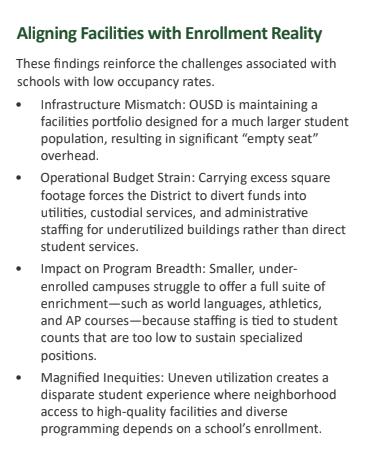
What we’ve learned
1. Some utilities, like heating systems, are controlled centrally. This means that all classrooms are heated at the same time even if they are not in use. Since utilities are the single-biggest cost to maintaining facilities, heating underused spaces is spending money on things that do not benefit students.
2. Schools that have these “extra” classrooms LOVE them. They can use them for enrichment programming, for small group interventions, and more. No space is wasted at any school. Conversely, schools that are at or above capacity have no flexible space for these same programs and services. You might see literacy interventions happening in the hallway, or OT and PT space happening on the playground.
Ok, we hear you Facilities Master Plan. We need to do something to improve these buildings and provide students adequate and excellent spaces to learn! Where do the funds come to do that?
Understanding Facilities Funding
All buildings need to be maintained to withstand the wear and tear from use, weather, things breaking etc. How does OUSD fund this necessary work? Three ways: general fund, bonds, and grants.
1.Unrestricted dollars/general fund: severely and systemically underfunded
Deferred Maintenance is the “practice of postponing necessary upkeep, repairs, or replacements due to budget, staffing, or resource constraints”
OUSD has an estimated $4 to $5 billion in deferred maintenance backlog. Let’s assume this is spread evenly across all 110 school sites - that would be $45.5 million dollars of deferred maintenance per school campus.
Deferred maintenance is usually paid for out of an organization’s general unrestricted funds. How much does OUSD budget for deferred maintenance? Now, $1 Million per year. Even if OUSD followed its commitment to provide $7M a year towards deferred maintenance, it would take over 571 years to erase the $4billion backlog.
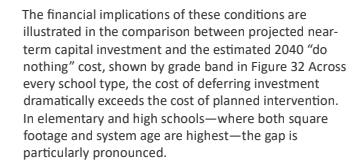
The 2026 Facilities Master Plan says:
2. Facilities Bonds: More adequate funding, restricted usage, mixed bag of impact
OUSD, like other public entities, uses bond funding to generate additional revenue to fund facilities repairs. These bonds are:
- Restricted dollars: they can only be used on facilities improvements, usually on facilities investments that will last over time vs. annual maintenance or repair
- Funded through property tax
- Approved by local voters on the ballot
- Overseen by an Independent Citizens' Bond Oversight Committee (CBOC) that reviews expenditures to ensure compliance with voter mandates.
OUSD’s bond strategy has been to use the majority of available funds to completely renovate or modernize a few school sites, and to use the remaining funds to undertake smaller projects broadly at many school sites.
OUSD has undertaken three major bond measures since 2006:
- Measure B (2006 - $435 million): Focused on school facilities improvements, largely spent prior to the 2019-2020 fiscal year, with remaining funds covering fire alarm projects.
- Measure J (2012 - $475 million): Aimed at upgrading science labs, classrooms, technology, and improving security. Major project: Fremont High School, Glenview Elementary
- Measure Y (2020 - $735 million): Targeted classroom repairs, seismic retrofits, and energy efficiency. Major renovations/modernizations: Garfield Elementary, Melrose Leadership Academy (Maxwell campus), Roosevelt Middle School, Coliseum College Prep Academy, McClymonds High.
(A note on implementation: Past audits and reports have highlighted challenges in bond fund management. A 2019 Alameda County grand jury report criticized the district for poor planning and high costs, stating “Within the facilities department, constantly changing priorities left the district without a facilities master plan, contributing to a district full of under-enrolled schools. Poor financial stewardship of the district’s nearly billion dollar bond program coupled with unnecessarily costly policies that do not directly benefit students have left OUSD with little to show in the way of completed school projects.” Additionally, the district prioritized building a $62 million new headquarters building instead of housing district staff at underutilized spaces at schools and using that budget to make needed repairs or modernizations at school sites.)
The Facilities Master Plan communicates that OUSD is in the planning stages for a future bond, which is projected to hit ballots in 2028. The 2026 Facilities Master Plan will guide the strategy of what work is funded by this bond.
3. Other sources of funding: government grants and philanthropy
I have a first grader. I’ve been active in engaging with the OUSD Facilities leadership & staff for the past two years. I don’t have a wealth of historic context, but can say that I’ve observed the current team is doing consistent work to bring in outside dollars to OUSD. Some great examples:
- Living Schoolyards: This effort, to modernize playgrounds and to add green space, was undertaken as a massive partnership with Eat.Learn.Play foundation, bringing in significant funding to the district. The district applied for and won other grants, such as a large one from CalFIRE, to extend this funding.
- State & federal grants and other programs: The team is up-to-date with many funding opportunities and has successfully won grant awards, specifically in the energy efficiency retrofit space (which is a huge win as OUSD is behind the times compared to other large districts. For example, most of our lighting is still fluorescent bulbs which are not even legal to sell anymore!). In a recent Facilities Committee meeting, the team discussed their strategy to pace and prioritize energy efficiency projects to take advantage of matching funding from the state and federal government.
- However, OUSD has also sometimes missed out on state matching funds for school construction due to poor timeline planning. For example,the school board recently voted to prevent East Bay Innovation Academy (EBIA) or Yu-Ming from accessing proposition 2 funds which could only be used by charter schools. Since these schools are housed in OUSD-owned facilities, the school board voted to reduce funding for its own facilities.
These funding sources, while critically important, are not always predictable or steady.
Do we have enough funding and time to repair our buildings?
When you add up the funding coming into the district from these three sources – deferred maintenance, bond funds, and grants/philanthropy – it is still not enough to ensure that every child in Oakland is going to have a safe school building to go to during their tenure at that school. The 2026 Facilities Master Plan suggests that some bond funding be used across all school sites (without specifying how or on what) but that each bond focus on 5 specific campuses, similar to the Measure Y bond approach. Put simply, when 75% of the district’s facilities are rated as deficient, it takes significant investment to bring those facilities up to a basic standard of decency, and then additional major investment to modernize those facilities for learning needs of today and tomorrow.
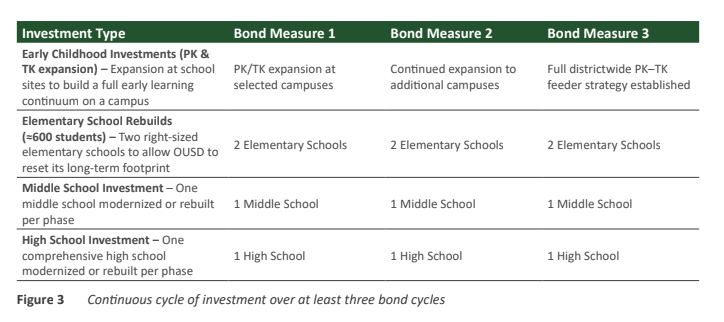
This hints at the second resource problem. It’s not only a problem of money, but a problem of time horizons. Upgrading and improving a building takes time, for good reason. Plans need to be made and reviewed to ensure safety and adherence to code, bids for service need to be collected to get the best partner to do the work at a fair rate, and work needs to be planned and calendared. But students are at schools for a small window of time: 3 to 10 years depending on the grade span of the school. The students who advocated for heat-pump A/Cs to be added to MLA (which set the standard for all major renovations in Measure Y!) will no longer be at MLA when the heat-pump is installed.
There is a true human cost to students attending class every day in our current school buildings, and that cost affects our most vulnerable students the most:
- Many OUSD school sites are unsafe, either due to seismic issues, inadequate cooling and shade on hot days, and inadequate ventilation.
- These health and safety issues affect students immediately and for their entire lives. For example, since our classrooms weren’t built to stay cool in today’s warming climate, overheated classrooms result in immediate learning loss, long-term academic achievement reduction, reduced earning potential, and life-long negative health outcomes.
- Many school sites also lack sufficient environments to support modern learning. Classrooms are too small and school sites don’t contain spaces appropriate for the wide variety of enrichment or educational programs happening at a school site. Some schools are so crowded that small group literacy intervention happens in hallways and elevator entrances.
- Put together, our aging and deficient facilities affect teacher and student morale. They cause students to stay home from school, or families to keep their kids home from school. This is especially true for students with disabilities or special needs. Deficient facilities are a safety issue, and they are an issue of equitable access to education.
Our current strategy of managing buildings means most OUSD students will not have access to a safe school for their entire tenure at that school.
So what do we do?
Rachael again, Everything above is my best attempt to lay out the facts as I understand them — the condition of our buildings, how the money works, and what the timeline actually looks like. What follows is different. It's what I think we should do about it, and why. You may land somewhere else, and I'd genuinely love to hear it.
We have to take action in two time horizons:
Help cool schools IMMEDIATELY
Overheated classrooms are a reality at schools across the district. 2,100 classrooms across OUSD lack access to air conditioning, AND there’s efforts underway to implement common sense, low-cost, high-impact, and IMMEDIATE solutions that would make improvements for our students as soon as next school year. Using a small amount of funds to improve health and safety for all students does not detract from the district’s ability to fund larger projects in the future.
Weigh in on OUSD’s Long-Term Plan
From the 2026 Facilities Master plan, page 101:
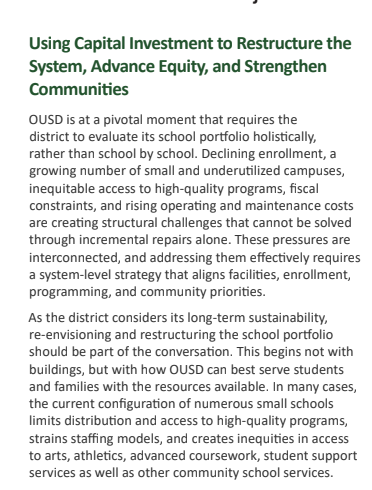
The Facilities Master Plan is explicit that the path forward requires hard community choices about which buildings to invest in, how to right-size a district that is using only 59% of its capacity, and how to stop spending money on heating empty classrooms while kids learn in unsafe ones.
That will mean different things to different people. For some, it raises the specter of school closures. That possibility is real and worth naming honestly. But a community planning process doesn't have to end there. It could just as easily mean directing more resources toward preserving historic school buildings, or investing in programs that make an under-enrolled school a destination worth filling.
What it does require is that we stop making the default choice — to maintain our current footprint while our buildings quietly deteriorate and our kids pay the price. Inaction is also a decision, and right now it's a decision that trades children's safety and access to education for the comfort of not having a hard conversation.
I am ready for that conversation, and I hope you are, too.
How to join the conversation
- Attend Facilities Committee meetings, traditionally the third Thursday of every month.
- Connect with your school board member!
- Engage with PSAC, who is helping lead a cross-stakeholder group — parents, students, teachers, staff, administrators, and the board — to shape how OUSD engages and makes decisions heading into the next budgeting phase.