

October 14 Board Meeting Recap
Lee esta publicación en español
Hello friends, welcome to our recap of the 10/14 school board meeting.
📣 Before we kick off, we’d like to share The Dig Speakers’ Bureau again. Our editorial team is available to come to your community or PTA meeting and give a 20-minute nonpartisan presentation on what’s going on in OUSD. It’s fun, we promise! A parent who saw one of our recent presentations emailed us this unsolicited review: “I LOVED your presentation. You broke down a messy and political situation super simply and made me feel empowered and knowledgeable.” If you’re interested, reply to this newsletter and let us know.
OK, let’s get into it.
📚Focusing on Literacy
This week, the Superintendent covered literacy in her report to the board. She spoke about the district’s focus on literacy in her opening remarks, and then passed the mic to Jamilah Sanchez, Director of Literacy. Sanchez reported on the district’s strategy, including curricula and professional development. She also shared that the number of students reading on grade level has increased by 1.3% (although Spanish reading proficiency dropped by 1.3%). Unusually, Saddler paused in the middle of her report to allow board and public comment on literacy.
Director comment
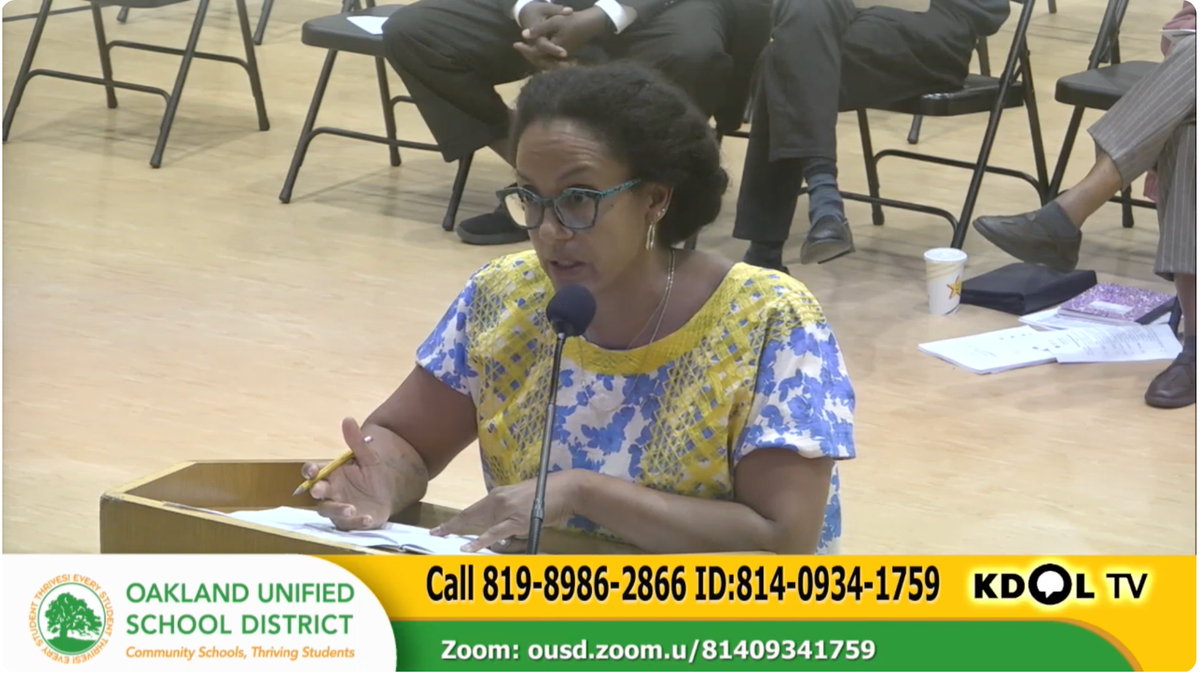
Berry asked Sanchez “We’re doing so much, but literacy rates are still not where we want. What’s missing?” Sanchez explained that any state that has made significant literacy gains (e.g. Mississippi) will tell you that it’s a marathon, not a miracle. You meet your goals by continuing to make incremental progress each year. Berry followed up: 📺“So you say you're making slow but consistent progress, your foot is on the gas. What's important for the board and leadership to protect so foot can remain on gas?” Sanchez said schools need literacy staffing. Principals don’t have enough time to fully support literacy, and they need teachers on special assignment (TSAs) to help. She encouraged the district to align its funding towards literacy.
Williams, who is consistently focused on supporting and retaining teachers,📺 commented that teacher turnover is the most important investment in literacy we can make. He said that when we lose 200-300 teachers a year it's hard to build staff knowledge about literacy.
Our take: It’s good to hear a Superintendent’s report focused on academic outcomes. And it’s great to see progress on English reading proficiency (although it is of course concerning that Spanish reading proficiency is falling). We are particularly glad to see the district investing in science of reading-based curriculum materials. We encourage the board to follow Ms. Sanchez’s advice: if literacy is our strategic priority, we should prioritize it in the budget.
📈 🎯Enrollment
Context: OUSD enrollment has been declining for years. As Superintendent Saddler explained, this trend is driven by declining birth rates and the high cost of living in the Bay Area. OUSD is not alone: enrollment is dropping for most large urban districts. Enrollment directly impacts OUSD’s budget, as the state uses the average number of students attending school to calculate funding. Because the state formula looks at the 3 prior years, a drop in enrollment this year likely won’t impact this year’s finances. (For the nerds out there: “For funding purposes, the state credits school districts with their [Average Daily Attendance] in the current year, prior year, or the average of three prior years, whichever is higher.”)
Notably, last year OUSD enrollment grew for the first time in 10 years. In his April 2026 report to the board, Director of Enrollment Kilian Betlach credited 📺the investment in enrollment stabilization, saying it has paid for itself at least twice over. When the board cut the budget this February, 2.4 positions were eliminated from the enrollment team, as well as 94% of its non-labor budget ($1M).
This week: Director Kilian Betlach delivered a preliminary report on 2026-27 enrollment. Key takeaways:
- As of September 8, year-over-year enrollment appears to have declined by 257 students, significantly more than the projected 75 student drop.
- The big story, according to Betlach, is the 103 student drop in KG enrollment. That's 4 classes. And we didn't just lose those students for 1 year, that's for the next 12 years.
- Newcomer enrollment (students who recently arrived in the United States and are learning English) significantly decreased due to ICE anti-immigration activities. (This is also a nationwide trend.)
- The number of students in self-contained programs (i.e. learning differences significant enough so that they cannot participate in general ed classrooms) has increased by 224, significantly above projections.
In explaining the decline, Betlach mentioned, as Saddler did, that this is partly driven by trends affecting every district. Kilian also reminded the board that the district had been doing local enrollment marketing, which had mitigated those trends: last year enrollment actually grew. He explained that the district "chose not to fund the enrollment team…You have to close strong, and we made a tough decision under difficult circumstances to take away that capacity for closing strong. It would not be great to assume that had no impact."
Director comments:
Berry: 📺“You said we have to face our enrollment trends. And one of the challenges I'm feeling is that we aren't facing it. We do not have a vision that's driving decisions.... right now it seems like we're operating the district in some kind of alternate reality.” Berry also asked Saddler how this will impact our budget, and the $30M reduction in expense the district already had to make when leadership thought enrollment would be higher. Saddler said her staff are working on the numbers. (As mentioned in the context section above, this year’s enrollment probably won’t impact this year’s budget.)
Hutchinson said “When you miss projections by 100s of students, that means we're going to be millions of dollars shorter in our revenue coming in for this year.” (See note above: this likely won’t impact 26-27.) Hutchinson also said that Saddler had visited Montclair with him, and committed that they wouldn’t consolidate classrooms and cut teacher positions due to low enrollment, and no school in Oakland would. “How will we fund that?” Hutchinson wondered.
Our take: It is deeply discouraging to see OUSD enrollment declining again after last year’s incredible turnaround. The most frustrating part is how predictable this is: when you cut the people doing the work, the work stops getting done.
You might be wondering, “Didn’t the board have to make cuts to keep the district solvent?” Yes, cutting expenses was a tough but necessary move, and we applaud the board for doing it. What we question is whether the cuts were strategic. The board’s guidance to the district leadership team was to protect investments in enrollment and attendance, and that clearly didn’t happen. District leadership also didn’t provide any scenarios, or explain how they decided to cut the enrollment staff. What were the other options for positions to eliminate, and how did they pick the enrollment team? We don’t know, because no scenarios or tradeoffs were presented to the board, and the board didn’t demand to see any. Even without knowing what the other choices were, it’s hard to imagine this was the best one.
🗳️Measure G
Context: Oakland residents can vote to provide additional funding to OUSD through parcel taxes. These funds are allocated to specific purposes, like libraries or career education. Citizens’ Bond Oversight Committees (CBOC) monitor and report on whether funds were spent on things the voters approved. Parcel taxes are intended to add or expand programs, not to pay for things the district was already doing.
Measure G provides funds to do 7 things, including retain teachers, maintain school libraries, and support programs that enhance student achievement.
Last night: Phillip Patrick, head of the Measure G CBOC, presented a report on Measure G spending. Patrick expressed concerns that the money was being spent on afterschool programs that didn’t have academic goals. The committee recommended that funds be spent on things closer to the spirit of the measure, like libraries. “We have a charter, we have a commitment to the taxpayers to put this money towards what the taxpayers voted for." He also noted that the district had pulled $6M of unspent measure G funds to cover other expenses. “We'd like to see those funds come back.”
Our take: We highly recommend reading Oaklandside’s excellent article on the fight over parcel tax spending. In that article, County Superintendent Alysse Castro said that reallocating Measure N and H contingency funds was legal, but misaligned with the intent of those measures. The district appears to be doing the same thing with Measure G. As Castro said, “ultimately [this] is a question for the voters, whether they feel like it’s what they were signing up for.”
Other news:
- PSAC member Matt Glaser released a “Consent Report Tracker” to help the community follow consent reports. Many of the district’s expenditures are approved via consent reports, which are not discussed by the board.
And that’s it! Only one more board meeting left before the election on November 3. Stay well, and don’t forget to vote!
Best,
Anna, Bekah, and Jess