
June 24 Board Meeting Recap
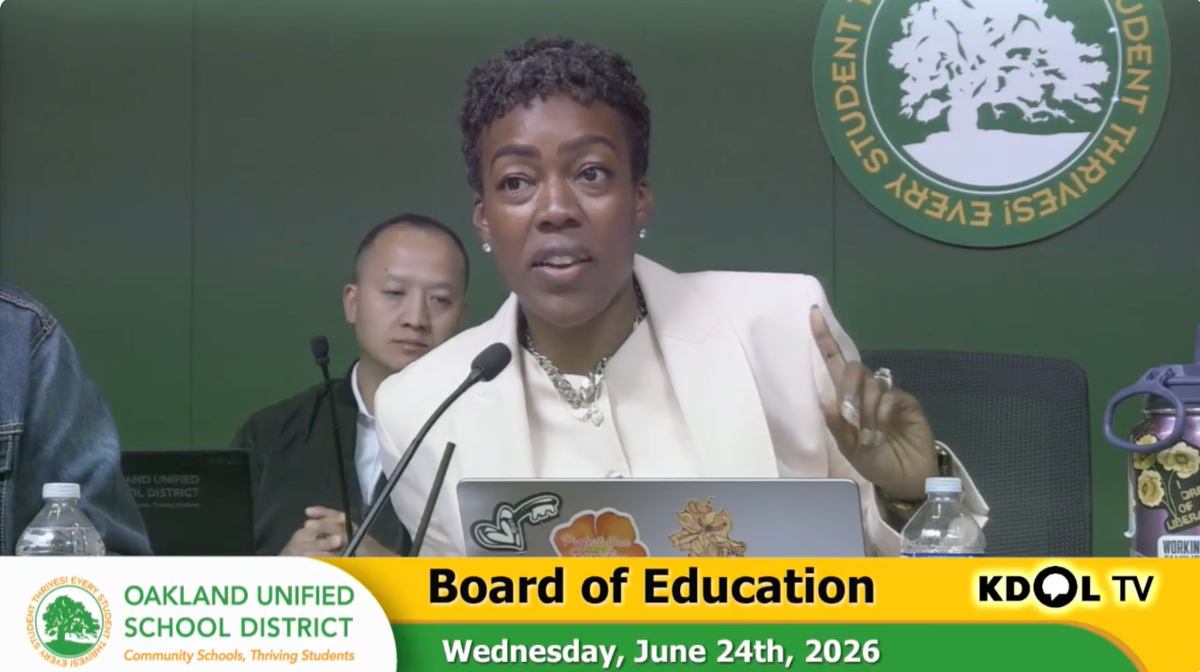
Lee esta publicación en español
Hi community,
It’s the last board meeting of 26-27! Reasonable people can disagree about the budget issues that dominated the agenda, and last night people did disagree, sometimes unreasonably! Read on to learn more, and email us to share your take.
⚖️ Financial Stabilization Implementation Plan & Budget
Context: At the beginning of school year 2025-26, OUSD was spending $100M more than it receives in revenue annually, and leadership at the time expected to run out of money this year or next year. The school board has been working with district leadership on a “Fiscal Stabilization Plan” to reduce expenses and avoid having to take out a loan, which would trigger a county takeover. (For more detail, see our recent budget background timeline.)
Last night: Deputy Superintendent Tara Gard, CFO Ryan Nguyen, and consultant Dr. Ruben Frutos presented an update on the Fiscal Stabilization Plan, and a final 2026-27 budget for adoption by the board.
Saddler opened this section with a statement praising the hard work done so far, and committing to the hard work still ahead. “Change is never easy, particularly when resources are limited. However, delaying action only increases the magnitude of future reductions.” Gard presented an update on the fiscal stabilization plan, and then Frutos walked the board through a presentation on the final budget. Gard also commented on the budget math that the Oaklandside has called “confusing." She explained there is a $22M deficit next year, but the plan is to reduce expenses by $30M more as a “plug”. If that plan is carried out, district revenue will exceed expenses by $8M.
Gard explains the math: $30M “plug” - $22M deficit = $8M increase to reserves
Public Comment:
Frequent commenter Assata Olugbala said of the Fiscal Stabilization Plan: “You are dead set on not considering certain things. And you have no ability to justify them. And I'm talking about closing schools. And you had 60 principals ask you to consider it.”
Parent Avi Ringer on the “plug”: “What indications are there that we're going to be able to find that money? Every trick and tactic has already been tried…Do you think that part of the presentation that we would have just heard might have talked about that? It wasn't even mentioned.”
Director Comment:
Berry praised the additional detail in this update, which included a line item report on how much each strategy in the plan is projected to save, which she has asked for in the past several meetings.
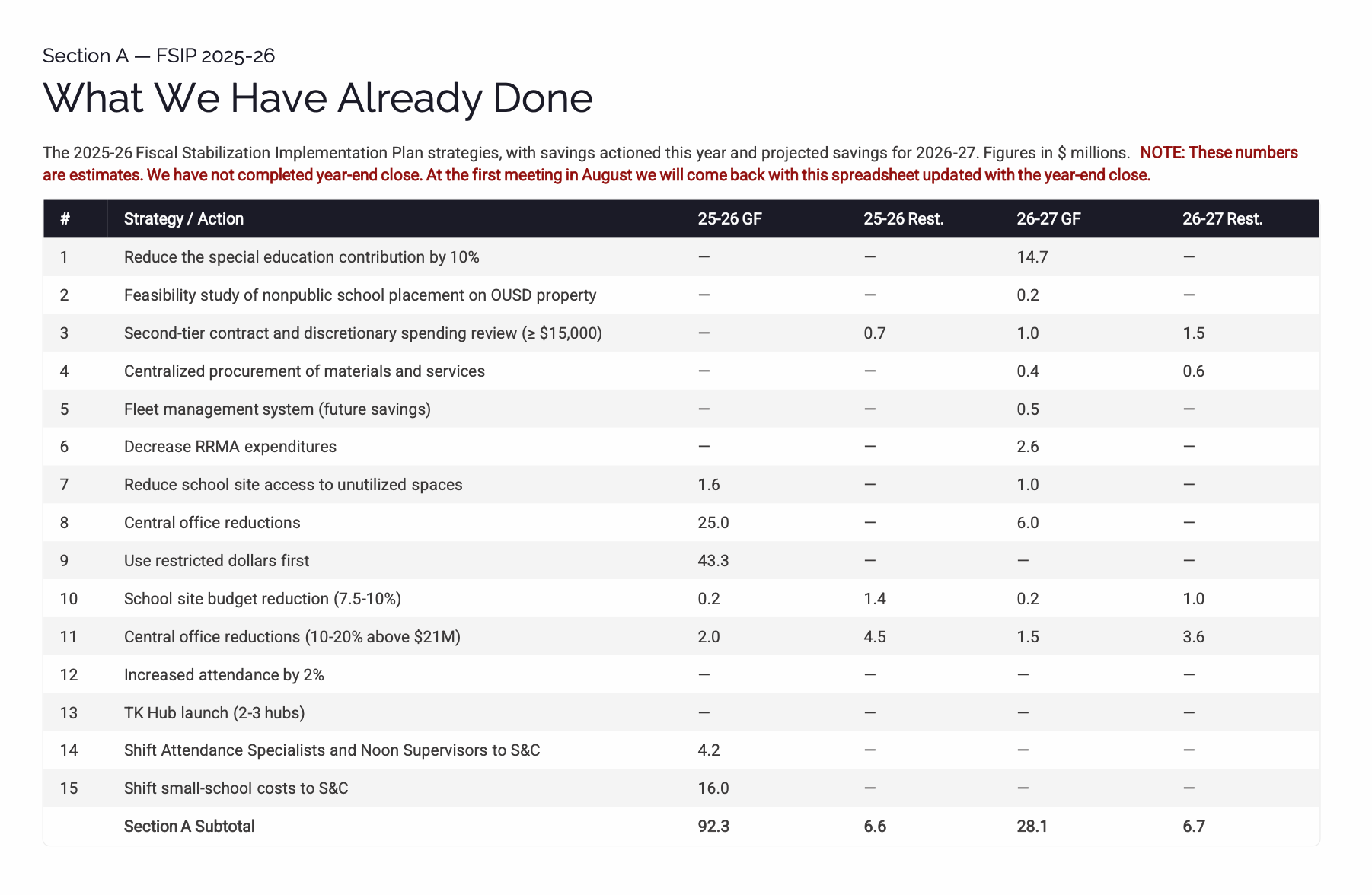
Berry’s called for the board and the district to grapple with the hard work left to be done. “What I think is a more serious concern is how we manage the deficit and contain it so it doesn't grow year after year, because the plan, as became clear today after today's conversation, is really just getting us through next year. There needs to be additional intensive work beyond next year, and it does have to start today — it should have started yesterday.”
Hutchinson, unconvinced by Gard’s explanation of how the numbers add up, said he believed the budget was fraudulent. Superintendent Saddler, Deputy Superintendent Gard, and CFO Ryan Nguyen all said the numbers are valid and reminded Hutchinson that they’re audited by the county. In response to Hutchinson’s accusations that the $30M plug was missing from the official budget, Nguyen provided a detailed walkthrough of the numbers, showing that plug is a large negative entry in the Books and Supplies category (object code 4000).
Latta asks about the hopeful upside from additional state revenue not included in this budget. (Frutos explained later that if state revenue is higher than expected, the plug could be reduced to $18M.) Latta also praised the board and the team for the hard work that significantly reduced the $100M deficit, noting that at one point many people didn’t think it was possible for the district to finish the year without going bankrupt. “I would just say the fact that it was messy… shouldn’t detract from the real work that has happened to stabilize our district.”
Williams addressed public comment calling for the board to consider school closures to stabilize the budget, as many principals have recommended. “The fact is, we have communities out in East and West Oakland that want to keep their schools. They really feel that it's valuable. They see that school choice has hurt them because they don't get the same opportunities. So I think we also, as a board, need to keep in mind that the decisions we make are for those who may not be sitting right here today, who may not be the strongest advocates, who may be working two or three jobs.”
Bachelor said she supported the budget "knowing that we do have that hard work ahead based on conservative financial projections, that we will have to make reductions in future years." She also asked folks to flood the governor's office with demands to fully fund public education.
Brouhard spoke passionately about how the district is finally making real progress on budget problems and hard tradeoffs. She said the board committed to avoiding 2 things, which they delivered: taking out a loan and a teacher strike. "So after 40 years in the district, I finally feel that I am being part of change."
The budget passed, with Bachelor, Williams, Latta and Brouhard voting yes. Thompson was absent, and Berry had stepped away from the dais when the vote was taken (but seemed to suggest in her comments that she was leaning yes). Hutchinson voted no.
Our take:
Last night President Brouhard noted “we’ve made a significant step towards restructuring our finances, and moved closer to a budget that centers the needs of 34K students”, we think she’s half right. This is significant progress! We respect the hard work this board has done delivering on some of the cost reduction strategies often called for by the community: central office cuts, management salary reductions, and reductions in contractor spending.
But is the budget student-centered? Here's the uncomfortable thing: almost everyone in this debate believes they're the one centering students. We don't have a shared definition of what it means to be student-centered. Directors and community members who oppose school closures point out that schools anchor their communities. Many school closures have been rushed and left families (usually black and brown families) without a real path forward.
Meanwhile, 60 OUSD principals (see their letter) and others argue that keeping underenrolled schools open means cutting the staff and programs that students elsewhere (and sometimes the same students) actually depend on.
We don't think the board has yet had to say, out loud, what "student-centered" means when small schools and full services are in direct tension. That's the hard conversation ahead, and we hope the Multi-Stakeholder Engagement Group gives the community space & clarity to weigh that tradeoff for themselves.
We, like Director Berry, also appreciated the increased transparency from the district’s financial staff this week. As noted above, the Oaklandside (and folks we spoke to who were in the room) called the plan “confusing.” That’s true: a budget that’s balanced because you have a plan to balance the budget is a bit of a head-scratcher. But the staff took pains to be open about that plan. Instead of responding to questions with platitudes like “different reports show different things”, they opened up spreadsheets to show the public where the money is going.
Finally, we must note that while we often appreciate Director Hutchinson’s clarity and advocacy, this week he disrupted the board’s ability to do business without listening to those attempting to answer his questions. We were not the only ones who noticed. At one point Student Director Simmons turned towards Hutchinson and said “This is just a reminder to us. We can ask our questions, but... we're humans.”
🧑🏻🏫OEA Tentative Agreement
Context: In February, the district agreed to give teachers an 11% raise over 2 years (13% for senior teachers). Per California law, the district analyzed the financial impact of the raise, and submitted that analysis to the Alameda’s County Office of Education for review. County Superintendent Alysse Castro responded on June 18. In that letter, Castro said that the Board had not yet identified how or when it will reduce expenses to offset the cost of the raise and balance the budget, and strongly encouraged the district to provide a list of tradeoffs it will make to afford the agreement “in the same meeting in which it plans to approve this multi-year salary agreement."
Last night: The board voted to approve the Tentative Agreement. Hutchinson abstained, Thompson was absent, and the remaining directors voted for the agreement.
Hutchinson pulled the item for a separate vote, and said that the board had not met Castro’s requirement of presenting a plan to afford the raises. General Counsel Lindsey responded that “the board has met the requirement of presenting a plan in the same meeting as the TA has been presented.”
Our take: We are happy to see our teachers getting well-deserved raises. We also agree with Superintendent Castro that we need to see a specific plan to pay for those raises. We don’t think the $30M plug in the budget meets the level of specificity Castro was asking for, or that the public deserves. To quote Castro, “While it is not uncommon for districts to leave details of future year reductions to be developed later, districts typically accompany such projections with a clear plan, timeline, and Board-approved direction regarding how those reductions will be achieved.”
📱Cell Phone Policy
Context: CA requires districts to adopt either a full or partial cell phone ban.
Last night: Executive Director of Safety Nelson Alegria presented a bell-to-bell cell phone ban policy for the board to adopt. This is supported by a majority of administrators surveyed, and 240 parents and 58 staff members signed a petition in favor of a phone-free school day. Saddler said we have a significant number of sites that already have this policy in place, where students are asked to place their phones in pouches.
Hutchinson questioned whether the appropriate financial impact analysis had been done. CAO Dr. Sondra Aguilera explained that ~$500K required for phone cubbies and pouches program will be funded out of Supplemental & Concentration funds.
Latta, Williams, Berry, Bachelor, Brouhard voted yes. Hutchinson abstained.
Our take: We’re pleased to see the district pass a clear policy, particularly given the recent Oaklandside report on how phones fuel school fights. It’s especially nice to see a policy developed with input from parent advocates, and passed with their help.
And that’s it for the 25-26 board meetings, friends! Email us to let us know what you thought of last night’s meeting. And we hope to see you in ‘26-27!
Off for now,
Anna, Bekah, and Jess