
November 12 Board Meeting Recap
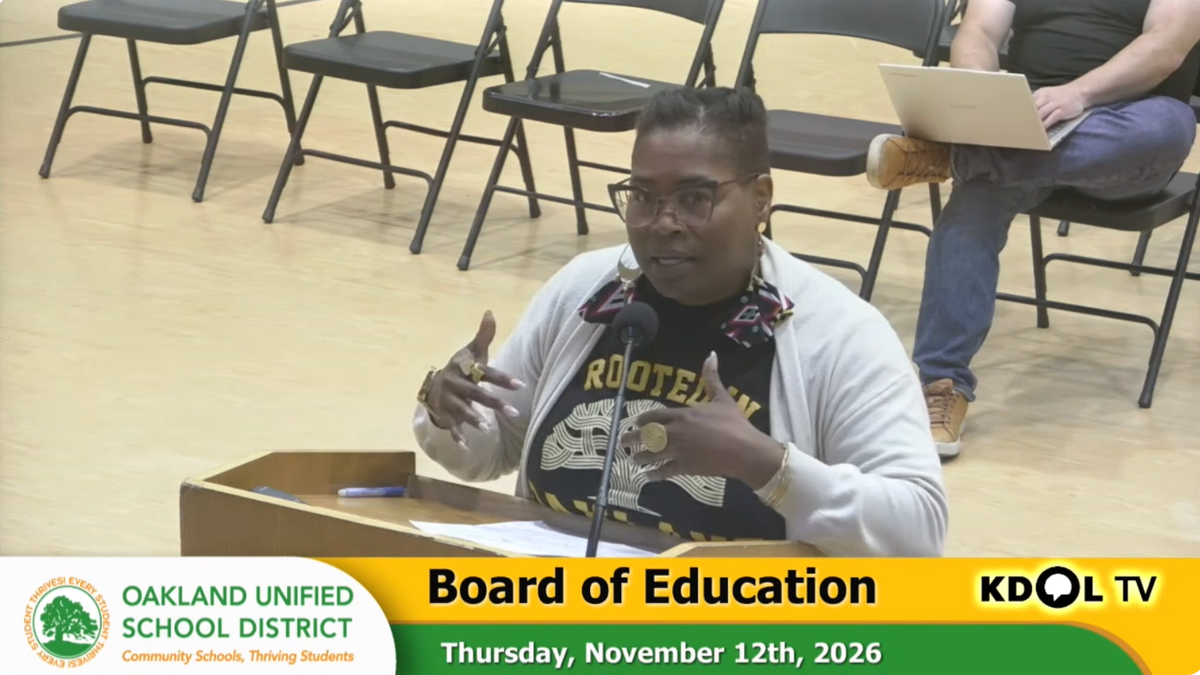
Hello community, and welcome to our recap of the 11/12 board meeting. The agenda was packed, so let’s dive right in.
Lee esta publicación en español
OUSD insolvency risk
Context: Fiscal Crisis and Management Assistance Team (FCMAT, pronounced fic-mat) is an independent, state-funded agency that helps school districts identify, prevent, and resolve financial, operational, and data management challenges. FCMAT looks for factors known to increase the risk of insolvency (e.g. management changes, loose financial controls).
FCMAT recently released a report saying that OUSD is in the “high risk” category. The report assessed the district’s finances through Jan. 31 2026, and operational practices through August. FCMAT leaders say if they’d included more recent financial data the risk score would have improved to 43%, but would remain in the high risk category.
Last night: FCMAT representatives Andrea Ward and Megan K. Reilly presented their report to the board. (While the report did include some positive indicators, the presentation only summarized the warning signs FCMAT saw.)
Key points:
- 95.4% of all unrestricted costs are salaries and benefits (up from 85 cents on the dollar as of 2nd interim). Ward said “you need to do something fast” to address that. (Spending almost entirely on salaries is risky because layoffs are the only way to reduce costs.)
- Labor agreements were approved without an understanding of the services that would be impacted to afford the agreements.
- The details in the stabilization plan didn't align to the budget. Reilly said, “When you have a plan that lists out the savings you'll achieve, and there’s no way to reconcile it to the budget document or know how much of this is in the budget or not…it makes it hard to track.”
Director Comments:
Thompson: “I believe you talked about how the plan isn't integrated with the budget...And that really scares me because it seems like you're almost making haphazard decisions.”
Latta asked FCMAT to confirm that the district’s risk score is going down, which they did. Then she asked for their top recommendation, and they said transparency. The FCMAT team explained, “The disclosures around bargaining are incomplete. We all value our employees, but what are we giving up?”
Williams and Bachelor both pushed back on FCMAT’s assessment. Williams pointed out that the current board was handed a deficit, and FCMAT’s assessment didn’t consider that. “When you talk about transparency, you weren't transparent yourself because you should know that the previous year impacts 25-26.”
📺Bachelor, in a particularly tense exchange, said it was unfair for FCMAT to “dock us” for the choices of previous leaders AND the choice to change those leaders. The FCMAT lead responded “This report in no way tells you how to do the job you have. And it certainly is a hard task... If you want to blame past leadership, fix it.”
Berry commented, “I continue to be baffled by when we get these analyses and reports, how preoccupied we are with the names people are calling us… It's a big red flag when we get something like this and everyone's saying there's no value to what the report is saying.”
Our take: FCMAT’s job is not to grade the board, or allocate blame, or tell the board how to address the district’s challenges; it’s to tell districts whether they see warning signs of financial risk. Their assessment is based on 30 years of data and experience with California districts. The board would do well to heed these warning signs, and we’re grateful some directors seem to be listening.
💸🎯Fiscal Stabilization Plan
Context: OUSD began last year facing a $100+M budget deficit. During the year the district implemented a “Fiscal Stabilization Plan” at the board’s direction. The plan has reduced the deficit, but work remains to fully stabilize district finances. The board has committed to further reduce expenses by $30M this year.
This meeting: Deputy Superintendent Tara Gard and Chief Financial Officer Ryan Nguyen presented an update on the budget, with 2 sections:
- An updated multiyear financial projection, which the district is required to provide when approving a labor agreement. (The board has come to a tentative agreement with the Building and Construction Trades Council, or BCTC.)
- An explanation of & justification for the district’s “use restricted funds first” strategy. This strategy spends restricted money (which can only be used for specific purposes) on expenses that were previously paid for by “unrestricted funds” (which can be spent on anything). This eases the budget crisis, which is caused by a deficit in unrestricted funds.
Notably, the presentation described a “pattern of resistance” to using restricted funds, and said “reflects a broader organizational pathology: administrators responsible for specific restricted funds have consistently prioritized protecting their funds' unencumbered balances over the district's overall fiscal health.” Gard acknowledged some pushback from staff on this language, and said she regretted using the word "resistance."
Director comment:
Hutchinson: “This is not a Financial Stabilization Plan update. At best it’s addressing one item… What used to happen in November is that the board adopted a set of strategies that were going to be used for budget adoption the following year. There has been no conversation about this! None!”
The board unanimously approved the tentative agreement with BCTC.
Our take: Gard’s explanation of the district’s use of reserved funds first was helpful. That strategy has been critical to alleviating the immediate crisis. It won’t fix OUSD’s budget problems forever, as the district is spending down restricted reserves that will eventually run out. But it’s the right thing to do right now, as it gives the district breathing room to make long-term changes.
We also agree with Hutchinson, this is not an adequate update. Last meeting (and in many previous meetings) Director Berry asked for updated numbers on projected savings for each item in the plan. This meeting’s update included no such numbers. At this point in the year, we think the board should be talking about guiding principles for the inevitable March round of layoffs. What programs are most important to preserve? What hard decisions will they make?
🧑🎓College & Career Pathways Funding
Context: In addition to state funding, OUSD receives money directly from Oakland voters via parcel taxes. These parcel taxes are dedicated to specific initiatives, like Measures N and H, which fund “college & career pathways” for high schools. (These “pathways” structure students’ high school experiences to connect directly with real-world work experience and high-demand careers.) Spending of parcel tax funding is monitored by Citizen Bond Oversight Committees (CBOC). CBOC commissioners have an advisory role, but not final decision-making authority.
Last night: Measure N / H Commissioners David Kakishiba and Marc Tafolla asked the board to return $3.5M in “unallocated funds” (unspent funds from previous years). The district appropriated these funds to help cover the budget deficit. The commission’s presentation reminded the board that the commission voted against the district’s plan to use the funds. The commissioners explained that the measure’s intent is to supplement this program, not pay for things the district is already doing. They also objected to the fact that the funds were not allocated per pupil, as the measure requires. According to Mr. Tafolla, this resulted in some schools receiving far less funding than they otherwise would have. Oakland Tech, the most affected school, received $384K less than if this funding had been distributed on a per student basis.
Director Comments:
Student directors Bloch and Tongun said the funds needed to be restored, and reported that the All City Council Student Union had “voted to support the reallocation of the $3.5M that were diverted from its original purpose of serving students for college and career readiness.”
Director Latta said part of why she ran for school board is because “I felt like a lot of decisions were getting made in service of specific programs and at the expense of the district as a whole… I would push back on anyone who says that it is raiding or stealing any resources.” Latta also reminded the commission that “nobody’s position was getting cut, and no pathway was getting cut.” Commissioner Tafolla responded that “additional people who would have been hired, services that would have otherwise been provided through the parcel tax are not being provided.”
Brouhard reminded the community that this idea of using measure funds to cover the deficit is not new. In fact, it was first proposed by former CBO Lisa Grant Dawson. Brouhard described it as inequitable that high school and middle school students have measure funding, while elementary students do not.
Berry, who also opposed returning the funds, said “Staying the course is so important right now.” But she added later, “If we’re not careful, we will treat this moment of fast-moving decisions as if we don’t have time for processes or a vision.”
Our take: We believe both the board and the Commissioners want as many OUSD students as possible prepared for college and careers. This fight wouldn’t be happening if the district’s finances were on firmer ground.
We see no reason to doubt the county’s investigation finding that this was a legal use of measure funds. We also believe the directors who said the budget crisis made it necessary to appropriate these funds. At this point in the school year there’s very little the board can do to save money, as no more staff positions can be cut for 2025-26. (By law, layoffs must be announced by March of the prior year.) Every dollar counts.
That said, we disagree with two points made on the dais last night. Several directors argued that the district spent the funds in the spirit of the measure, as dollars went to staff that support college readiness. But as Commissioner Tafolla explained, the spirit of the measure is not just “college and career pathways”, but more investment in that program. Spending the money on programs the district would have funded anyway seems like “supplanting not supplementing”, which the measure was designed to prohibit. (County superintendent Alysse Castro agrees: She told Oaklandside the use of funds was legal, but misaligned with the intent of the measure.)
Second, we disagree with the directors who framed the commissioners as “valuing one program over the district as a whole.” Voters gave the district Measure N / H funds specifically to support college and career pathways, because it’s an important program. The LCAP plan (the closest thing the district currently has to a strategic plan) says A-G completion is a key district goal, and career pathways have increased A-G completion rates in Oakland. Survey data also shows that career pathways are a key reason families choose to enroll in OUSD. Advocating for funding to be aligned with a critical district goal is very much consistent with supporting the district as a whole.
Note: This section originally said the county's report found that different rules applied to spending reserve funds. The report did not say that. We have corrected the text, and apologize for the error.
Also on the agenda
- The board considered a 3-year contract with Curriculum Associates, makers of iReady. Several dozen community members left eComments on the contract, and the board decided to ask that the contract be shortened to one year.
In other news
- As readers of this newsletter are surely aware, the November election brought change to the board. We are grateful to every candidate, as running for public office and serving as an elected leader takes enormous bravery and commitment. Congratulations to the winners of each race, we hope the new board will demonstrate the vision, collaboration, and courage necessary to navigate the difficult choices ahead.
- Measure G1 commissioner Brandon Wall has proposed a resolution calling for the board to restore Measure N, H, and G1 funds. If you agree that the funds should be restored, you can sign a petition in support of the resolution.
- Budget decisions are happening! Over the next several weeks, the team that runs our Local Control Accountability Planning (LCAP) process will be working with the Parent and Student Advisory Committee (PSAC) to give feedback on school site budgets. The November 18 and December 17 meetings are critical opportunities to provide input on school budgets for the next three years (as LCAP planning runs in 3-year cycles).
Wow, you made it to the end of this very long recap! Thanks so much for spending your time and brain space on these tough issues. See you in our December 9 meeting recap, and in the meantime Happy Thanksgiving.
Best,
Anna, Bekah, and Jess