
June 3 & June 10 Board Meeting Recap
Lee esta publicación en español
Welcome back to The Dig! The board had two meetings in the last two weeks, which we decided to cover in a special double issue.
One quick note before we dive in: We know reasonable people see this board differently. Some readers think we're too critical; others think we're not critical enough. We try to call it as we see it, and we welcome pushback when you think we've missed something.
⏪ Public Hearing Redo
Context: The Brown Act is California's open meeting law, which requires local government bodies like the OUSD Board of Education to conduct the public's business openly and to give the public 72-hour advance notice of what will be decided.
Last week: The Board addressed two Brown Act violations from previous weeks. In the May 13 meeting, the Board adjourned without allowing for public comment on non-agenda items. (Many public speakers had registered that night to comment on the district’s handling of antisemitism.) To “cure” that Brown Act violation, the Board opened the 6/10 meeting by inviting speakers who had missed their comment opportunity last week to the podium to speak.
The board also re-opened the 6/3 public hearing on the draft budget and the LCAP, presumably to address a complaint Director Hutchinson made about the materials changing at the last minute (though that was not explicitly stated). Hutchinson said this violated Brown Act’s rules about making materials available for review in advance.
📺Hutchinson points out the change in the financial statements attached to the meeting agenda
Brouhard, in a prepared statement, formally acknowledged the 5/13 Brown Act violation. She acommitted the board to ensuring public comment would be heard at future meetings.
Our take: Brouhard called for “grace for those who make mistakes” during one of the Brown Act discussions in these 2 meetings. In general, we agree, and for that reason we believe these violations are genuine mistakes and not intentional efforts to silence public comment. The Brown Act violations on 6/3 and 5/13 were unusually serious, and we’re glad the Board corrected them.
But lack of process and purposefulness are a regular feature of board meetings. The board members interrupt each other (Hutchinson most frequently). The staff often don't seem to directly answer board questions. Audience members interrupt public speakers. We believe that everyone at board meetings is there because they care about kids and their future. But good intentions alone aren’t enough, and even well-meaning decisions can still cause real harm, especially when the right processes aren’t followed. We hope the Board takes this as a lesson, one that brings more care, better decorum, and a stronger commitment to the kind of process that keeps public trust intact.
✏️ Draft Budget
Context: At the beginning of school year 2025-26, OUSD was spending $100M more than it receives in revenue annually, and leadership at the time expected to run out of money this year or next year. The school board has been working with district leadership to reduce expenses and avoid having to take out a loan, which would trigger a county takeover. (For more detail, see our recent budget background timeline.)
Last week: Deputy Superintendent Tara Gard presented a draft budget with more numbers and detail than we saw in the 3rd Interim report. Gard responded to Hutchinson’s previous question about why expenses went down by $100M by saying there had been a “placeholder” in the December numbers:
📺Gard walks through the change in projected 26-27 expenses
Gard and CFO Ryan Nguyen both reminded the board that the presented budget assumes the district will find a way to save $30M additional dollars, either by increasing revenue or making more cuts. Gard noted that one of the possible sources of such revenue is increased revenue from the state, which many expect but the district is not yet including in its revenue projections. (Materials shared in the 5/27 meeting showed that could lower the gap to $18M.) But Gard urged caution, saying “I want to be sure and clear with the board that we still have a $30 million pending budget balancing solution.”
Latta spoke to this point, explaining “I understand that having a deficit, having a placeholder for reductions for next year, feels like we're saying we're not stable… As we close out this first year out of receivership in over 20 years, we're also confidently standing on our own two feet and saying that we will meet our obligations. The board, by adopting this budget, and staff as well, is committing to the work of addressing the $30 million.”
Hutchinson opposed passing a budget with a placeholder for future reductions. “To say ‘maybe we can figure something out next year’ is not how the budgetary process works. At some point there needs to be an admission that the work hasn't been done this year to address the deficit for next year. This idea that we'll pass a budget and then next year figure out how to cut it in order to stay solvent is not proper fiscal and budgetary management.”
Berry asked again for more detail on the fiscal stabilization plan (a plan adopted by the board in December, listing action items to keep the district solvent). Berry asked that the “TBDs” in the plan be replaced by actual dollar amounts, so the board can track progress on the expense reductions on which this plan depends.
📺Berry asks for a concerete update on the Fiscsal Stabilization Plan
Hutchinson noted discrepancies across the financial reports presented, asking “Superintendent Saddler, there are three different sets of numbers in here, which I don't understand. Which one is the real set of numbers?” (Berry added she shared some of Hutchinson’s "curiosity" about the changing numbers.)
📺Hutchinson on discrepancies between reports
Gard responded that different reports show different information, adding “we don’t make up numbers just to make [them] up.” Hutchinson replied that the 26-27 budget and the 26-27 section of the Multiyear Projections contain some of the same information, so it should match.
At that point Brouhard asked the district’s financial consultant Dr. Ruben Frutos to answer Hutchinson & Berry’s questions. Frutos repeated that “different budget documents serve different purposes.” Hutchinson objected to a consultant answering a question he had directed at the Superintendent and her team. Frutos attempted to answer several times, and Hutchinson continued to interrupt, saying “He’s not gonna tell me how this process is supposed to work, I’ve sat through this process year after year and, I’m sorry, I know it better than he does.” This exchange grew so tense that Brouhard called a recess, and closed the public hearing after the recess ended.
Our take:
We see the same discrepancies in the numbers that Hutchinson and Berry mentioned, and we think both the board and the public deserve an explanation. “Different reports show different numbers” is insufficient. If there’s a real reason the deficit and total 26-27 expenses are different across documents, a financial professional should be able to explain it.
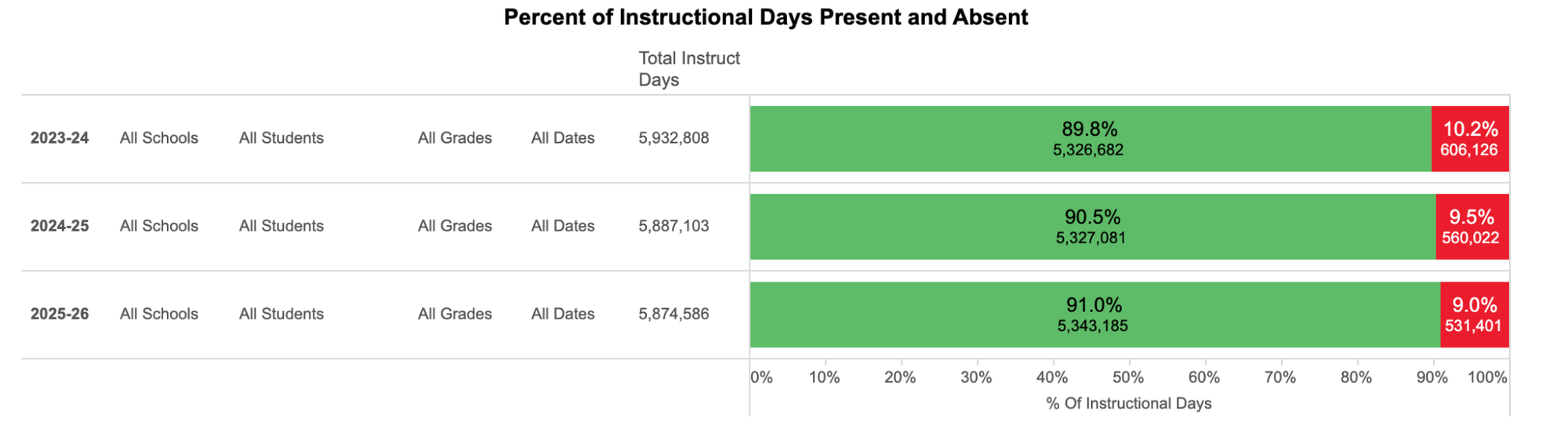
We, like Berry, have been waiting meeting after meeting to see an update on the December Fiscal Stabilization Plan. The district committed to specific actions to reduce the deficit, and the board and the public should know how those actions are progressing. Gard did present an update in the 6/4 Budget & Finance Committee meeting, but as Berry noted, the update had a lot of “TBD” placeholders. It also omits several of the action items the district planned in December, including improving attendance by 2%, which would have earned the district $10M more in revenue. The district’s attendance dashboards show attendance did increase this year, but only by 0.5%, which presumably means this action item delivered only $2.5M in savings. Has that been factored into the financial plan? Has the district found a different way to save $7.5M? We have no way of knowing, because the board hasn’t been updated on this action.
This board and its chosen leadership team have scored some real wins: they made hard choices that significantly reduced the budget, and funded a teacher raise that averted a strike. But as Ms. Gard has said repeatedly, difficult work remains. And the presentations we’ve seen have been frustratingly opaque on how that work is progressing. There are multiple former teachers on the board, and they should be demanding the same thing from their leadership team that they required of their students: show your work! If we can’t understand the district’s financial reporting, we can’t be confident that the district will retain local control, or that the budget protects what’s most important for our students.
The district’s finance team will present the final budget at the 6/24 board meeting. We hope they will paint a clearer and more complete picture, as Ms. Gard promised Director Berry.
Antisemitism in OUSD
Context: Last year the California Department of Education ruled that OUSD created a discriminatory environment for Jewish students. Read more about the case in the Oaklandside.
Last week: The district played a video updating the community on its progress on the corrective actions agreed to with the CDE.
📺 OUSD update on actions from settlement with CDE on antisemitism
The mood in the room was tense, with public speakers expressing disappointment about the district’s handling of antisemitism, and commenters in the room verbally harassing the public speakers.
Our take: Members of the public should be able to speak at board meetings without fear of harassment or intimidation. Audience members often harass public speakers who are addressing contentious topics, like antisemitism, labor contracts, facilities repairs, and school closures. In her comment on the 5/13 Brown Act violation, Brouhard committed the board to “maintaining order at board meetings to prevent intimidation of speakers.” We hope to see that commitment upheld.
🏫 LCAP & PSAC
Context: Every district in California has a “Local Control and Accountability Plan”, a document describing the district’s goals for students, and what actions and budget decisions will support those goals. The LCAP plan specifies how OUSD will spend non-base funds, including its “supplemental and concentration” dollars (extra state money the district receives to support high need students like English learners, low-income students, and foster youth). To try and stabilize the budget, the district has moved certain line items from the base fund to supplemental and concentration funding. PSAC (the parent committee that oversees LCAP) is closely following these changes to the LCAP plan.
Last week: The district held a public hearing for the 2026-27 LCAP plan. LCAP coordinator Diana Sherman reviewed what has been cut from the LCAP budget as a result of the fiscal stabilization plan. Those cuts are listed on slides 11-17 (and for those of you who want to dive into the weeds, more detail is available in the School Site Funding Profile).
The Parent and Student Advisory Committee (PSAC) commented on these cuts in the 6/10 meeting, noting that “Last-minute decisions were made by staff to zero out or drastically reduce particular non-labor expenses in certain LCAP actions. We were not made aware of those decisions at our last PSAC meeting.”
Our take: It’s helpful and sobering to see the cuts to LCAP funding required to balance our budget enumerated. We particularly appreciated seeing these cuts aligned with our LCAP goals, which help make it clear what we’re losing when we make these hard tradeoffs. As we’ve said before, we applaud the board’s resolve in approving the district’s proposed cuts; we hope the board shows similar resolve in focusing OUSD’s remaining money on the district’s most important goals, like those enumerated in the LCAP.
⚠️ Public Safety
The board also took up two student safety-related items.
First, the Student Committee for Safety & Violence Prevention presented its findings. The committee conducted a survey of 745 middle and high school students, only 55% of whom reported they felt safe in OUSD schools. The committee shared a number of recommendations for increasing student safety, including improving bathroom safety and investing in strategies for interrupting violence like Restorative Justice.
The board also heard a safety update from Nelson Alegria, Executive Director of Safety. Alegria explained how the district’s approach to student safety has changed since the George Floyd resolution, eliminated the OUSD school police and ended on campus policing.
Our take: We were impressed by Mr. Alegria’s report. We weren’t following OUSD policy closely at the time of the George Floyd resolution, and we were glad to learn about the district’s shift towards school-based violence interruption strategies. We hope this work continues, as the student survey makes clear there’s a lot more important progress we need to make so our students feel safe.
📢 Principals to the board: we're still here
This week, principals also came to the mic to remind the board that Oakland administrators are among the lowest paid in the region, and they are still waiting on the District to start contract negotiations. Principals noted that central office employees and other bargaining units have received raises, and that principals are equally deserving of fair pay.
They are often the first responders when a crisis hits our schools like violence, behavioral emergencies, ICE activity. Our principals and administrators absorb two or three jobs every time a position gets cut. The speakers emphasized “Pay, safety, and workload.” as the key issues on the table.
📅 See you on June 24th
The final budget vote is June 24th. The principals will be watching, so will we, and we hope you will too.
RSVP: June 24 OUSD Board Meeting Partiful invite
Best,
Anna, Bekah, and Jess