
September 23 Board Meeting Recap
Lee esta publicación en español
Welcome, OUSD community members. We’re so glad you’re here with us for another board meeting. The evening’s discussion focused on the district’s finances, but there were a lot of other issues on the table as well. Read on to learn more!
✉️ County Superintendent’s budget letter
Context: Alameda County Superintendent Alysse Castro sent a letter last week conditionally approving Oakland’s budget. The County Superintendent monitors district finances and can take control if the district runs out of money. Last year, Castro’s letters sharply criticized the district’s financial management. This letter was more balanced: it praised the district for the hard choices that kept it solvent last year, and urged leaders to tackle the problems that remain.
At this meeting: The board voted on a response to the letter that committed the district to $30M of expense reductions in 2026-27, and future work to address the structural deficit.
Director Comments:
Bachelor and Brouhard celebrated the progress acknowledged in this letter, and said there is still work to be done. Latta noted that for the first time in a while, the County Superintendent’s letter contains no surprises, which is progress.
Berry and Thompson agreed that the progress was encouraging, but asked for more transparency about next steps. Berry pointed to the “growth opportunities” in the letter, “in particular not knowing which [expense reduction] strategies will be implemented today or in 3 months.”
Public Comments:
- Matt Glaser, Parent Student Advisory Committee (PSAC) Co-Chair: “[Alysse Castro] is saying good job.”
- Frequent commenter Assata Olugbala: “The reality is, your grade is an F. But they’ve given you a chance to deal with your F.”
Our take: Latta is right: there are no surprises in this letter. As we’ve been saying for months, this board made hard decisions that saved the district from insolvency in 2025-26, AND there is very difficult work left to be done. Castro, an experienced analyst of district finances, sees it the same way.
Perhaps the most important takeaway from this letter is that the Alameda County Office of Education (ACOE) has examined OUSD’s budget numbers, and reported no fraud or inaccuracies. It is just not credible at this point to claim (as Director Hutchinson has) that the district is lying about its budget. We have concerns about the district’s finances, but fraud is not one of them.
📊 Financial Stabilization Implementation Plan Update
Context: OUSD started last year with $100+M budget deficit. At the board’s direction, the district adopted a “Fiscal Stabilization Implementation Plan”, which kept it afloat by cutting ~400 positions from the central office budget and shifting expenses that had previously been paid out of the “unrestricted general fund’ into restricted funds. (Learn more about Restricted vs. Unrestricted at Understanding OUSD’s Budget.)
This meeting: Deputy Superintendent Gard started with some history: for 25 years, the county has given OUSD’s budget a “qualified” rating, meaning the district may not be able to pay its bills in the near future. Gard said “we've been failing for 25 years, and we're going to change it.” She then presented an update on the plan. The plan’s most urgent goal is to reduce expenditures by $30M in the current year (as Castro’s letter noted).
This update provided helpful clarity on the impact of last year’s reduction. The district reduced recurring expenses by $29M, almost all of that coming from the $25M saved through layoffs in the central office. The rest moved money between funds. That lowers the risk of the general fund running out of cash, but does not shrink the deficit.
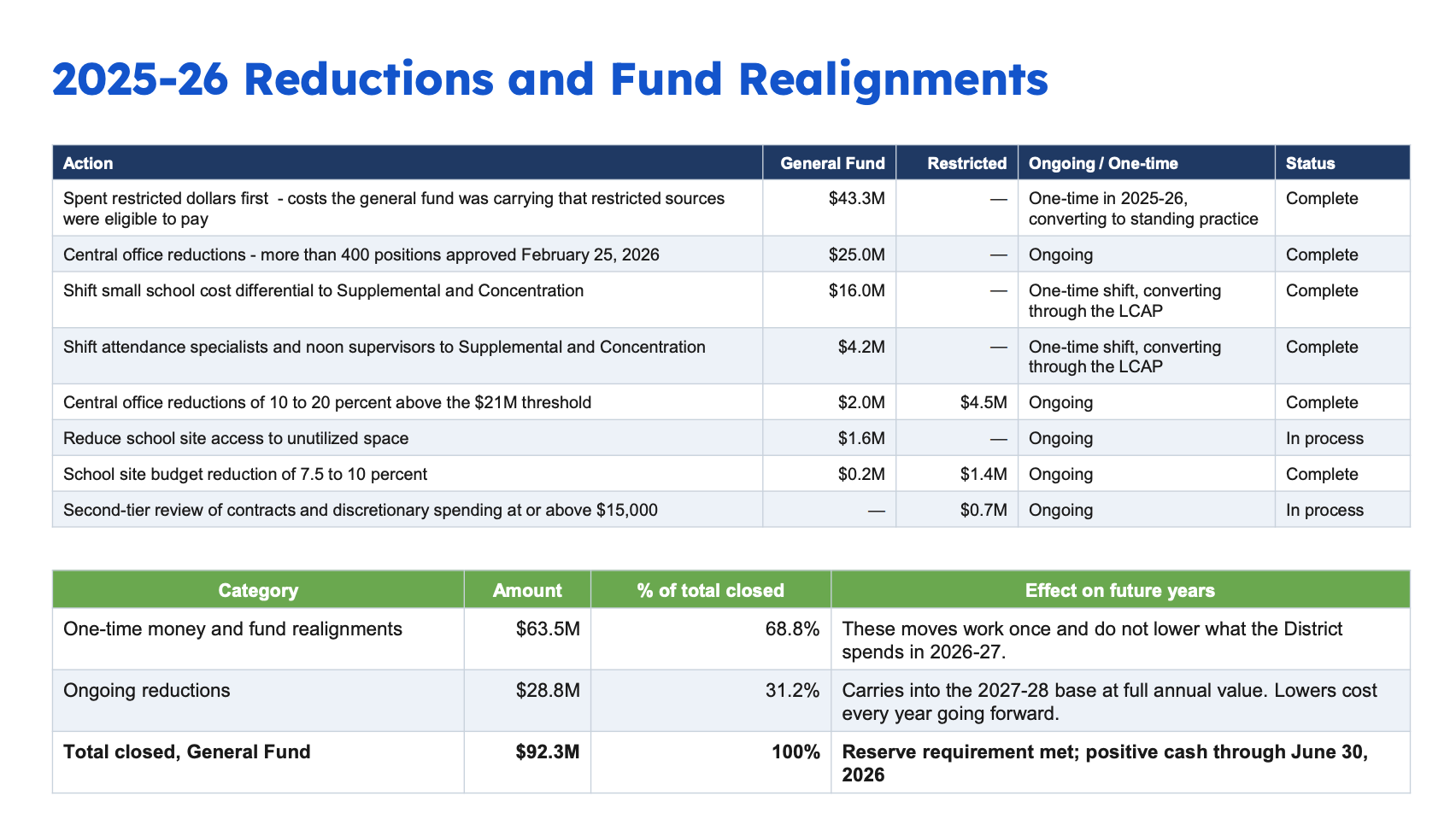
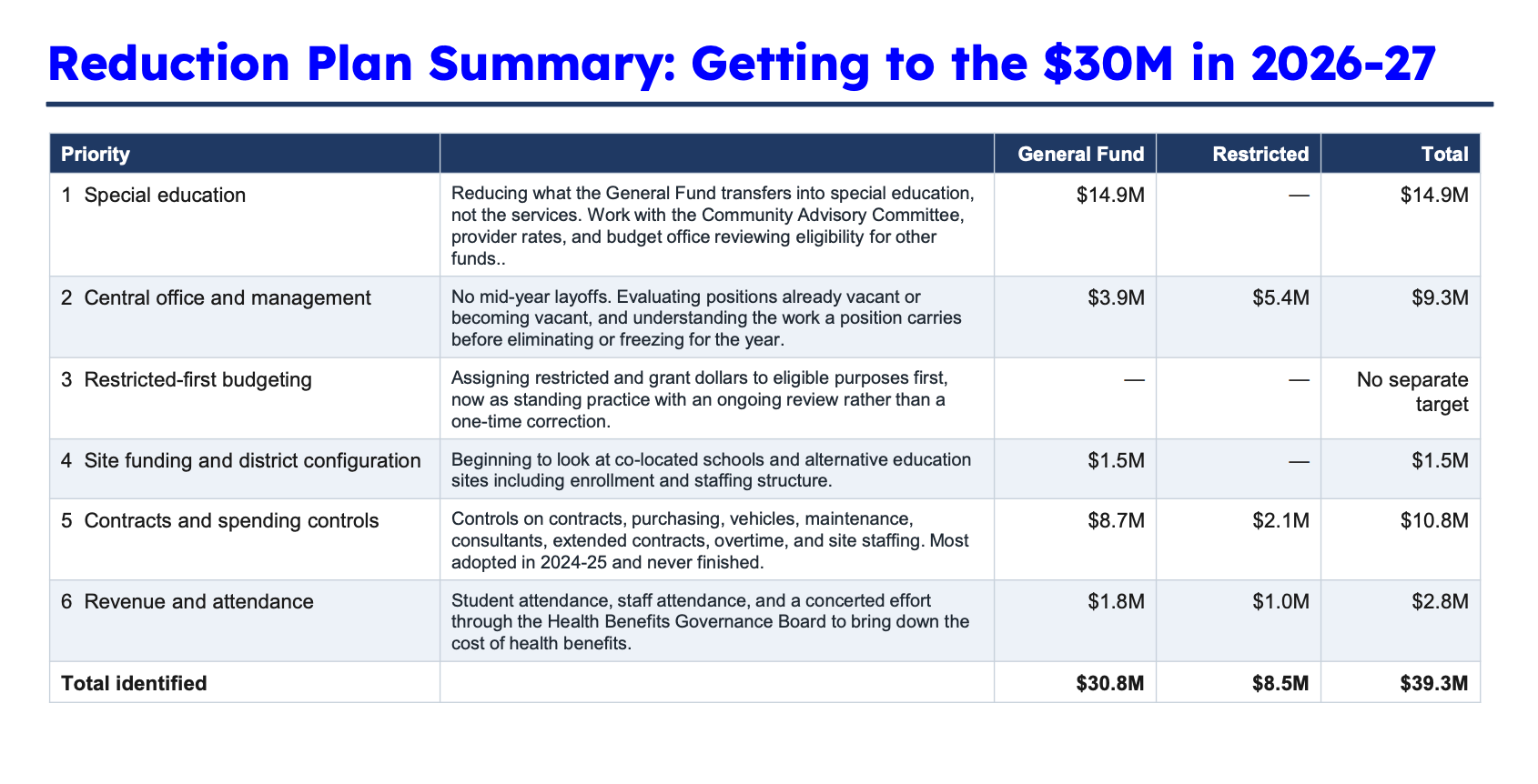
The presentation also provided an update on strategies to meet, or beat, the $30M deficit reduction target.
Director Comments:
Bachelor commented “We have made real progress, but there's still work to do. I support this plan, and it gives us a disciplined process and a clear timeline.”
Williams noted, as he often does, that the board had to make many cuts when COVID funding ran out. “We inherited the problem in 2024 and had to figure out how to move forward.” (Williams has been on the board since 2020.)
Latta stressed that the Special Education item isn’t about cutting services, but about reducing how much the general fund contributes to them. She said “reducing the contribution is actually an equity issue because it forces our district to make sure that we are providing for disabled students the same services that we provide to their general education peers.” (In a follow-up email, Latta explained the idea: offer some supports that special education students need to all students, so the district can pay for them from other sources such as Measure G/G1, Prop 28, and ELOP.)
Thompson said he was “skittish” about moving expenses into restricted funds (since restricted funds have very specific limitations about how money may be spent).
Hutchinson wanted to see a more specific plan. “Does the superintendent and staff realize we need to make $30M in cuts? This was supposed to be the plan to show us how we're making those cuts. And there's not one actionable item in here.”
Berry also asked for more concrete reports on progress. “What's missing are the answers to the questions that I've been raising. Some of those targets are missing, and I feel like we're too late in the game for missing targets… At this point we need to know: if we were to implement these strategies, how much is that worth to us — to this year's budget and to next year's budget?”
Brouhard echoed Berry, saying “What I'm looking for in the next 2 months is specifically what kind of positions, what kind of cuts. I want to see how we make these targets in a more specific way.” (Unlike Berry, she is “confident we will get that information.”)
Brouhard limited directors to one round of comments. Hutchinson moved to allow a second round. The motion failed, with Berry, Thompson and Hutchinson voting in favor and the remaining directors voting no.
Our take: We understand why Gard started with a history lesson. We cannot tackle these challenges as a community until we understand how the district arrived here.
History is in the eye of the beholder, but for the record, here’s the story we see: OUSD has struggled financially for 25 years, partly because of structural challenges like declining enrollment and an unusually high number of schools. In 2020, a one-time windfall of federal COVID money gave the district a few years of breathing room. Some leaders in the community, including former superintendent Kyla Johnson-Trammell, thought that closing schools would permanently stabilize district finances, and tried to make that happen before the COVID funds ran out. The majority of the current board disagreed with that strategy, and Johnson-Trammell left the district.
Some observers (including this author!) assumed OUSD would go bankrupt when Johnson-Trammell left. But the board, Superintendent Saddler, and their financial advisors found more breathing room: unused restricted funds. OUSD had almost $200M of restricted funds (dollars that can only be used for specified purposes) at the end of 2024-25. Shifting more costs into restricted funds eased the cash crisis. The board has made some progress ($29M) in reducing ongoing expenses, but most of the fiscal stabilization work ($64M) has come from spending down restricted funds.
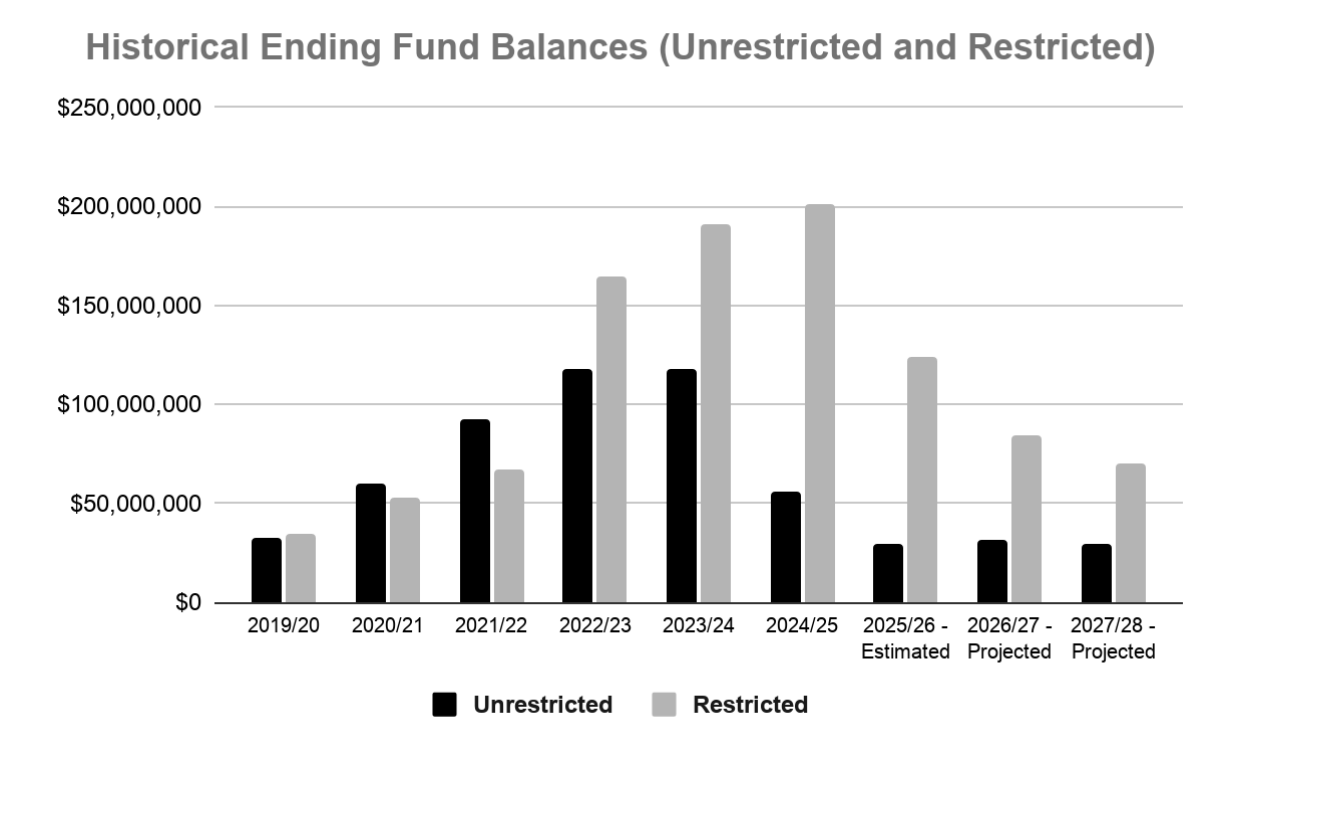
So if that’s the story, where does that leave us? We are glad the board saved OUSD from bankruptcy by spending down restricted funds. But that does not fix the problem. OUSD still spends more money than it receives every year, and eventually the cushion of restricted funds will run out, just like the COVID money did. It would be heartbreaking if that cushion runs out before the district has a plan to fix its structural deficit. Until we address that deficit, the district, and our kids’ schools, will teeter on the brink of crisis.
In that context, we strongly agree with Berry, Hutchinson, and Brouhard: This plan needs more specifics to be credible. It should have clear targets and show progress towards those targets, so we know before the end of the year that the district is on track to remain solvent. And more importantly, it needs to be clear about how the district will make permanent changes that bring spending in line with revenue. Moving expenses between funds is a temporary solution, not a plan for financial stability.
We were disappointed that President Brouhard limited the board to one round of questions about this plan. We suspect it’s because she wanted to limit Hutchinson’s time at the mic, which is understandable given the tenor of Hutchinson’s recent comments. But the board needs time to ask tough questions about this plan, and they didn’t get it this week.
👀 Also of note at this meeting
- The board recognized the 3 winners of OUSD’s Teacher of the Year award: Dawn James, Ilya Olinger, and Megan Hatschek. We were delighted to learn that Ms. James taught Director Thompson’s son, who became a professional dancer and appeared in The Lion King!
- The board provided an update on actions the California Department of Education mandated the district take to address antisemitism. (Mini-take: it was disappointing that the district again responded with an AI-generated video. As commenter Carol Delton noted, a robotically voiced video doesn’t convey genuine concern.) You can learn more about the antisemitism allegations at Oaklandside.
- Several Montclair parents and one teacher showed up to speak out against classroom consolidation. More than 200 parents have signed a petition protesting the consolidation of four classrooms into three.. One parent commenter told the board: “Consolidate schools, not classrooms, to fix the budget deficit”
- Student Board Members are working on improving the phone ban, based on the results of their recent survey.
📢 Elsewhere in the News
- You can now participate online in the Multi-Stakeholder Engagement Group (MSEG)! You might have noticed we keep plugging MSEG. This group is the only district forum where we see real conversations about restructuring beginning to happen. We try to turn up whenever we can, and we’re so glad that we can now participate even when the meetings conflict with our evening mom duties. 🙂
- MSEG has a new tool for understanding how the district allocates staff to schools. It’s a good way to see how your school is funded.
Thanks, as always, for reading.
Best,
Anna, Bekah, and Jess 💚 💛